AuxPoW stands for auxiliary proof of work. It is associated with merged mining: a way for compatible proof-of-work activity to support an additional blockchain without treating the two chains as one ledger. The name sounds like a new coin or a separate mining algorithm, but neither description is a reliable definition.
The clearest way to understand it is to follow the evidence. One chain accepts a particular proof structure that connects its candidate block to work performed in a compatible mining process. The details depend on the protocol. This guide explains the roles, the boundaries, and the questions a miner should ask, rather than offering a universal configuration recipe.
Begin with a concrete relationship
Dogecoin's official mining explanation describes its introduction of merged mining with compatible Scrypt-based cryptocurrencies in 2014. Litecoin and Dogecoin are a familiar example of this relationship. The important idea is reuse of compatible work, not the visual similarity of coin symbols or a promise that every pair of networks can be combined.
Treat that example as an entry point, not a substitute for the participating chains' rules. A valid arrangement requires explicit support on the relevant side of the relationship. Two projects can share an algorithm while lacking the protocol support or software integration required for a particular merged-mining arrangement. Compatibility has several layers, and each should be identified separately.
Parent and auxiliary are technical roles
In a typical description, the parent side supplies the proof-of-work context and the auxiliary side accepts a proof tied to it. These names describe roles in verification. They do not establish an ownership relationship, a shared treasury, or automatic control over both communities.
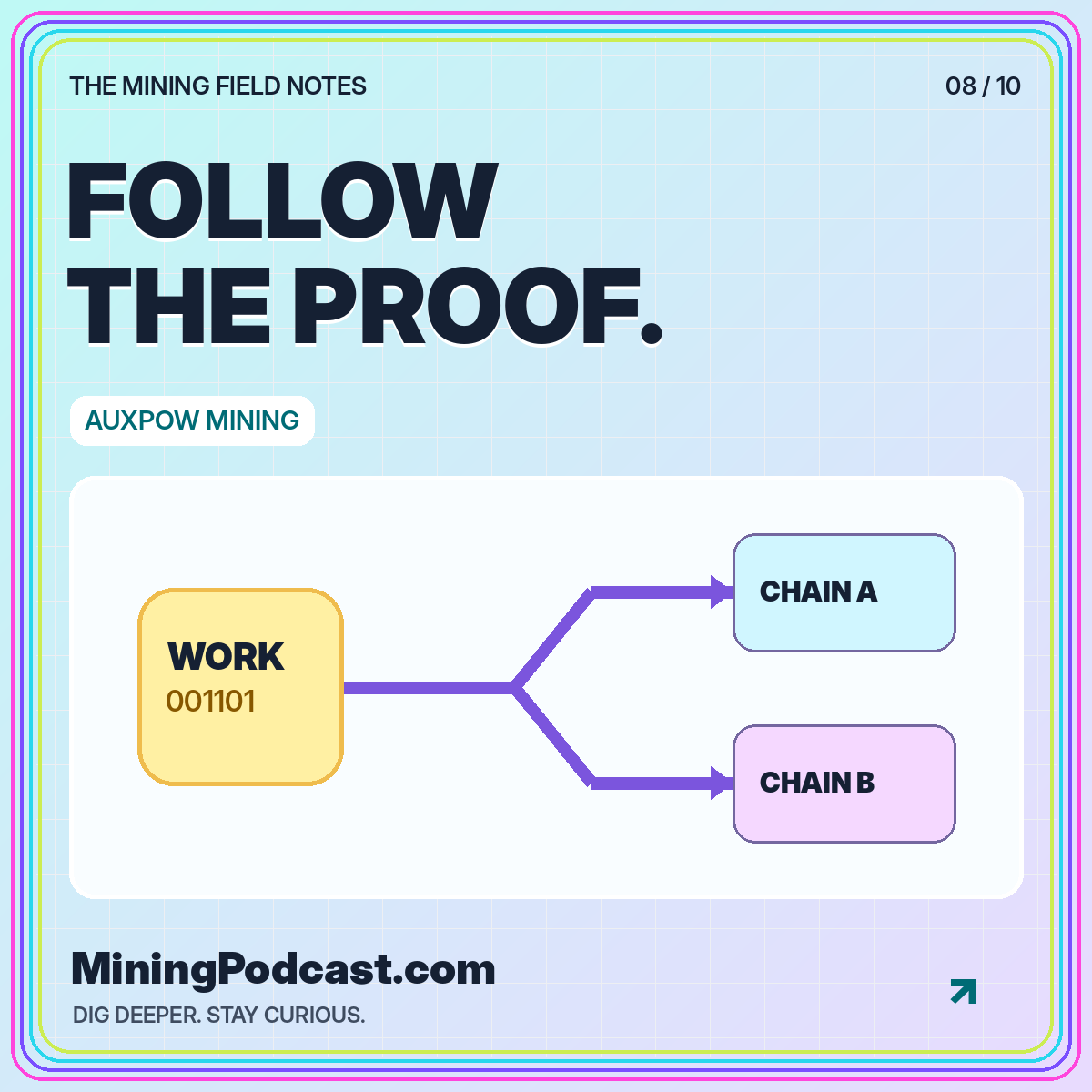
Keep the two ledgers separate in your mental model. Transactions, balances, and consensus requirements do not simply merge because some mining activity is shared. A diagram with two independent chains is more useful than a picture of two coins inside one box. Label where work is committed, where evidence is checked, and where each chain records its own resulting block. Avoid drawing arrows that imply an automatic transfer of funds.
A conceptual evidence trail
At a high level, an auxiliary block commitment is connected to the data being worked on, and a proof lets the auxiliary verifier check that connection and the relevant work. That statement is intentionally conceptual: exact serialization, tree structure, chain identifiers, and validation conditions belong to the particular implementation.
For an introductory notebook, use four labels: auxiliary candidate, commitment, compatible work, and auxiliary verification. Write one sentence explaining each arrow. This exercise helps prevent the common mistake of assuming that merely announcing support for two coins creates a valid protocol relationship. The verifier needs a structured proof, not a marketing claim. Technical implementation work should begin from the actual project's maintained documentation and tests.
Why not every successful result serves both chains
Different chains can have different targets and validation conditions. A result relevant to one may not satisfy the requirements of the other. It is therefore misleading to imagine that every accepted parent-chain block must arrive with a matching auxiliary-chain block, or that every auxiliary success requires a simultaneous parent success.
Think in terms of checks rather than synchronized rewards. Each chain evaluates the evidence according to its own rules. On a dashboard, record which chain a reported event belongs to and whether the display is showing a block, a share, or an estimated reward. This small labeling habit prevents several distinct processes from being compressed into one ambiguous success counter.
What a participating pool actually adds
A pool can coordinate the relevant software, construct work, track contributions, and apply payment rules. That is an operational service layered on top of protocol capabilities. Supporting a merged-mining arrangement requires more than attaching an extra coin logo to an otherwise unchanged website.
A useful service review asks which networks are supported, how rewards are accounted for, whether any proceeds are converted, and what happens if one part of the integration is unavailable. Record the difference between technical participation and customer entitlement to a particular payout. A pool's ability to receive an asset does not automatically tell you how, when, or whether that asset is distributed separately to its users.
Shared work is not a complete cost model
Merged mining is often summarized as receiving an additional reward for the same hashing effort. That captures the reuse of work but leaves out operational details. Monitoring, software maintenance, integration failures, service fees, settlement policies, and equipment expenses still need attention.
For an educational comparison, keep hashing power fixed and list the additional assumptions separately. Do not multiply a previous profit estimate by the number of coin names in the arrangement. The result depends on what work is actually accepted, what proceeds the service credits, and what costs the operator incurs. No protocol label removes ordinary uncertainty about running equipment or dealing with a service provider.
Three forms of compatibility
First check the hashing workload. A device must perform the intended algorithm; the general word “ASIC” is insufficient. Next check protocol support for the specific merged-mining relationship. Finally check the practical implementation: node software, pool integration, work distribution, and payout configuration.
These layers can fail independently. Hardware compatibility does not imply that the pool supports the auxiliary chain. Pool support does not mean a particular account is configured for the expected settlement arrangement. And a supported payout asset does not necessarily identify the chain being mined. The Scrypt compatibility guide expands this method into a worksheet for reading mining-service claims.
Security questions without slogans
Avoid the shortcut that an auxiliary chain simply receives every security property of a larger chain. Actual security depends on participation, incentives, validation rules, and the behavior of the systems involved. Shared work is one part of that picture, not an all-purpose guarantee.
A useful interview asks which assumptions the design introduces and how operators detect a broken integration. Ask what a verifier checks, what a pool monitors, and how failures are reported. Distinguish protocol behavior from a provider's operational record. A strong explanation should be able to describe an adverse scenario as clearly as a successful one, without resorting to reassuring adjectives.
A small diagramming exercise
Draw a miner, a coordinating pool, and two separate chains. Add one arrow for work sent to the miner, another for results returned, and separate arrows for the evidence submitted to each chain. Draw payments in a different color from work. You should now be able to explain why sharing work and receiving two separate payouts are not the same statement.
Under the diagram, write five open questions: algorithm, protocol support, software implementation, accounting, and settlement. Answer each from a relevant technical or service document. Any unanswered question is an information gap, not permission to assume the most favorable arrangement. Compare your diagram with the explanations in our Litecoin collection and Bitcoin collection.
Explain one failure without losing the distinction
Imagine a fictional pool whose parent-chain work continues while its auxiliary integration becomes unavailable. The exact effect would depend on the software and service terms, but the scenario is useful for testing your diagram. Which monitoring signal notices the problem? Which records remain available? What does the participant see, and what does the settlement policy say?
Do not invent answers for a real provider. Use the exercise to identify the documents and support questions needed before the arrangement is understood. A technical explanation that can only describe the successful path is incomplete as an operating explanation, even when its account of the protocol is otherwise sound.
The takeaway
AuxPoW is best understood as a way of verifying compatible work across a defined relationship, not as a universal extra-profit feature. Keep chains, proofs, services, and payments distinct. That separation makes technical explanations easier to follow and commercial claims easier to question. Explore the AuxPoW topic page for the audio field note and related guides before moving from a conceptual diagram to implementation-specific documentation.