Litecoin mining has its own vocabulary, equipment compatibility questions, and pool arrangements. Treating it as Bitcoin mining with a different logo leads to avoidable confusion. The first distinction is the proof-of-work algorithm: Litecoin uses Scrypt, while Bitcoin mining uses a different hashing scheme. Hardware that is specialized for one should not be assumed to work on the other.
A practical introduction therefore starts with compatibility, then moves to accepted work, pool terms, and operating conditions. This guide also separates Litecoin mining from receiving Litecoin as a payout for some other activity. Those experiences can look similar on a balance screen while representing very different work underneath.
Start with the algorithm, not the coin image
The technical material in the Litecoin Learning Center identifies Litecoin's proof of work as Scrypt and describes its parameters. That protocol identity is the starting point for interpreting equipment and software. An attractive product name, a familiar wallet logo, or the word “crypto” on a listing does not establish compatibility.
Write an equipment brief in plain language: the intended network, the exact mining algorithm, the device's supported algorithm, the controller software, and the intended pool connection. Leave any unknown item blank until it can be verified. This brief helps distinguish a genuine technical match from a marketing association and gives a support conversation something more precise than “Will this mine Litecoin?”
What Scrypt changes in the conversation
Scrypt was designed with memory-related work as part of its construction. That history does not mean that specialized mining hardware cannot exist. It is important to separate an algorithm's original design goals from the commercial hardware built to perform a particular workload. Our Scrypt coin mining guide explores this distinction without treating every Scrypt-based project as interchangeable.
When comparing devices, keep the algorithm label attached to the hash-rate unit. A number in gigahashes per second and a number in terahashes per second cannot be meaningfully ranked just because the second prefix is larger. A measurement describes performance on a particular task. The task must match before the measurement can help answer a compatibility or efficiency question.
Litecoin and merged mining
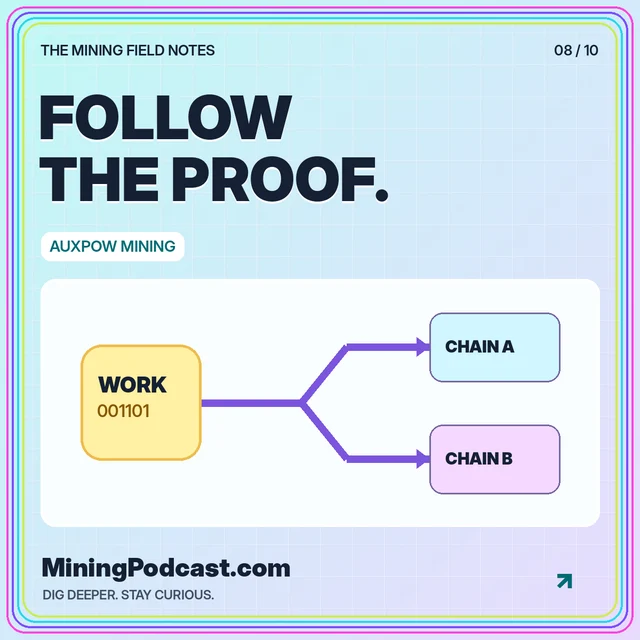
Litecoin is often discussed alongside Dogecoin because compatible mining arrangements can contribute work to both networks. The mechanism and the payout service are separate layers. A pool may manage merged mining and distribute rewards according to its own policies; a participant still needs to understand what currencies are earned, converted, retained, or paid out.
Do not translate “merged mining” into “double profit.” The phrase describes how compatible proof-of-work activity can be reused, not an unconditional financial result. Additional service requirements, fees, settlement choices, and operating costs still matter. Read our AuxPoW explanation for the relationship between parent-chain work and the auxiliary chain's verification rules.
Shares are not the same as blocks
A pool uses shares to account for contributed work. Shares accepted by the pool are not all successful blocks on the underlying network. Confusing these two events can make a busy-looking dashboard seem to promise a stream of block rewards that it is not actually reporting.
For an observation log, distinguish submitted shares, accepted shares, rejected shares, and any estimated hash rate derived from them. Preserve the interval over which the estimate was calculated. If a dashboard changes rapidly, wait for an appropriately longer sample before drawing an operational conclusion. The objective is to understand the accounting and identify persistent discrepancies, not to react to every movement in an estimated number.
A pool-comparison worksheet
Create a worksheet with separate rows for supported algorithms, payout method, fees, payout thresholds, credited currencies, conversion arrangements, and account controls. Add a column for the date each term was checked. A statement copied from an old discussion should not automatically override the service's published terms at the time of use.
Include questions about downtime, inactive accounts, and changes to withdrawal destinations. Ask whether the advertised return includes all merged rewards or only one part. Record whether a displayed amount is estimated, payable, or already settled. A clear answer is more useful than an impressive chart that combines several categories without explaining them. This method is about reading terms, not endorsing a particular pool.
Electricity and the whole installation
Use hypothetical arithmetic to learn the units. A device drawing 2.5 kilowatts for 20 operating hours consumes 50 kilowatt-hours during that interval. Multiply by an illustrative energy price only after writing down that the price is an assumption. The result describes machine energy cost, not a complete operating statement.
A facility also needs an appropriate plan for power delivery, heat removal, noise, maintenance, and monitoring. Have electrical requirements assessed by a qualified professional and follow the manufacturer's documentation. Do not infer installation suitability from a photograph of a miner on a desk. The ASIC mining collection connects compatibility questions to efficiency, airflow, and records without providing improvised electrical instructions.
Receiving LTC does not identify the work
A service might pay Litecoin even when the participant performs work on another network or provides a different service. The payout currency is a settlement choice. It does not, on its own, prove that the underlying activity contributes Scrypt work to Litecoin.
To clarify a claim, ask three questions: what task is the machine performing, what network or customer receives that work, and how are proceeds converted into the payout asset? This separation is especially useful for services that advertise “mine any coin” or present many coin logos beside a single piece of equipment. Trace the work first and the payment path second. A consistent explanation should account for both.
Keep wallet custody separate
A payout address can be shared for receiving a transfer. Wallet recovery phrases and private keys serve a different purpose and should not be supplied to a mining pool as routine setup information. Be cautious when support instructions blur this distinction or ask for secrets unrelated to providing work.
Document the approved payout destination, the account's authentication method, and the process for changing configuration. Keep a private recovery plan for the wallet itself. For an educational project, practice documenting the workflow without collecting anyone's real secrets. The safest demonstration data is deliberately non-sensitive and clearly identified as such. Screenshots should hide account details that are not necessary to understand the lesson.
Common beginner questions
Can a Bitcoin ASIC mine Litecoin? An ASIC specialized for Bitcoin's hashing workload is not automatically compatible with Litecoin's Scrypt workload. Check the exact supported algorithm rather than the general label “mining machine.”
Does a merged-mining pool always pay both LTC and DOGE separately? Payment arrangements depend on the service. Some arrangements may involve conversion or different payout settings. Read the current terms instead of assuming that a technical capability determines settlement behavior.
Can a higher hash-rate number settle a purchase decision? Not by itself. Compatibility, measured power, operating conditions, reliability, and complete costs all affect the practical meaning of the specification. This guide deliberately avoids a universal purchasing recommendation.
Keep a first-session record
A useful learning record begins before the first observation. Write down the intended network, the exact workload, the service terms being examined, and the labels expected on the dashboard. Afterward, note which labels were clear and which required clarification. This can be done as a documentation exercise without purchasing or operating equipment.
The exercise often exposes a gap between a familiar currency name and an unfamiliar payment arrangement. Keep that gap visible until the work and settlement paths can both be explained. A complete description is a better milestone than a screenshot that shows activity but leaves its meaning uncertain.
Build understanding before scale
A useful first Litecoin mining exercise is a complete diagram: network, algorithm, device, controller, pool, payout process, and wallet. Add measured or hypothetical values only after labeling which they are. The diagram makes missing information visible and prevents a payout screenshot from standing in for an explanation. Continue with the Litecoin topic page and its audio primer to connect the vocabulary to a coherent workflow.